
This guide is our complete walkthrough of USRN contract terms, written from 16 years of healthcare staffing experience and placing 300+ Filipino nurses in U.S. skilled nursing facilities under the Grandison Gold Standard.

A USRN contract is the legal agreement between you — an internationally educated Registered Nurse — and the U.S. employer or recruitment agency sponsoring your move to the United States. It defines your salary, working hours, contract length, visa sponsorship, and dozens of other terms that will shape your life in the U.S. for the next two to three years.
Before you sign, you need to understand what’s in it — and just as importantly, what should not be in it.
At a glance:
The contract you sign today will govern your life in the United States for years.
Get it right, and it becomes the foundation of your American Dream — a stable career, fair pay, a clear path to permanent residency, and the chance to bring your family to join you.
Get it wrong, and the consequences can be severe: hidden deductions, sudden reassignments, punitive breach fees, and in the worst cases, outright abandonment by your sponsoring agency once you arrive in the U.S.
We at Grandison have seen both sides. Many of the Filipino nurses thriving with us today joined us only after being abandoned by other agencies — sometimes during visa retrogression.
This guide exists so that does not happen to you.
Every USRN contract should clearly define each of the following. If any are missing, vague, or worded ambiguously, treat that as a signal to ask more questions before signing.
What it is: The length of time you are contractually committed to your employer or agency.
Standard range: 24 to 36 months (2–3 years).
What to look for: A clearly stated start and end date, or a clear formula for when the contract clock starts (typically the day you begin work in the U.S., not the day you sign).
Red flag: Any duration longer than the signed contract without explicit justification, or contracts that allow the agency to extend the term unilaterally.
What it is: Your hourly rate plus all forms of supplemental pay.
What to look for:
Red flag: Vague language like “compensation to be determined upon arrival” or “in accordance with company policy.” Your rate must be specific and in writing before you sign.
What it is: Non-wage compensation — health insurance, paid time off, incentives, and more.
What to look for:
Red flag: Benefits that only begin after an extended probationary period (3+ months), or benefits described in language so vague you can’t actually price them.
What it is: Which visa your employer is sponsoring and who is responsible for what.
What to look for:
Red flag: Any contract that asks you to pay employer-side visa fees, or that goes silent on what happens during retrogression. Many Filipino nurses have been abandoned by agencies during retrogression — your contract should specifically protect against that.
Learn more about how Grandison supports nurses through visa retrogression →
What it is: Where, exactly, you will work in the United States. Though note that for most staffing agencies, exact location and facility assignment happens at the later part before departure for USA as visa retrogression can affect job orders and placements after years of waiting for your arrival in the USA.
What to look for:
Red flag: Contracts that give the agency unilateral, unlimited reassignment rights to anywhere in the country at any time.
Note: a limited and protective reassignment provision is actually a benefit, not a risk. The difference is whether reassignment exists to protect you (from a failing facility) or to give the agency power over you.
This is where Grandison’s Secure Placement Model is structurally different. As our Operations Director, Shmuel Carmen, explains it:
Read the full breakdown of our transparent USRN contracts →

What it is: Who pays for your pre-deployment training, certifications, and orientation.
What to look for:
Red flag: You pay every cost upfront with no reimbursement structure, or training costs become disproportionately punitive if you ever need to exit the contract.
See how Grandison’s geriatric and cultural training program prepares nurses for U.S. roles →
What it is: Support to physically move you from the Philippines to the United States.
What to look for:
Red flag: No relocation support at all, or basic support that’s structured as a personal loan you repay over your contract.
What it is: The amount you would owe if you ended the contract early.
This is the most misunderstood part of a USRN contract.
Breach fees are normal. Ethical agencies invest tens of thousands of dollars in your training, visa sponsorship, and relocation. Recovering some of that cost if you leave early is reasonable and legal.
What an ethical breach fee looks like:
Red flag: Breach fees that increase over time, do not decline as you complete service, are vastly disproportionate to the agency’s actual investment, or are paired with threats of immigration enforcement.
What it is: The conditions under which your employer (or you) can end the contract.
What to look for:
Red flag: “At-will” termination with no defined cause, or contracts where termination immediately voids your visa with no transition support.
What it is: Who holds your personal documents — passport, visa, green card, licensure records.
This one is non-negotiable. Under the AAIHR Code of Ethics, no agency or employer may withhold your passport, green card, certifications, permits, visas, or any other official documents for any coercive purpose.
Custody must be transferred to you as soon as the certification and immigration process reasonably allows.
Red flag: Any contract clause that allows the agency to hold your personal documents. Walk away from any contract that contains this provision, regardless of how it’s worded.

If your contract contains any of the following, do not sign. Find another agency.
The clearest way to understand a good contract is to see one in action.
Every contract we issue under the Grandison Gold Standard meets the following standard:
For the full picture of how we operate ethically — including dispute resolution, document custody, and compliance with U.S. labor law — see our companion guide on legal transparency in nursing contracts.
Read more on Grandison’s record in ethical recruitment →
See the 50 Grandison nurses who completed their USRN contracts →
Before you sign, get clear written answers to these six questions. Any reputable agency will answer all six without hesitation.
If an agency cannot or will not answer these questions clearly, that itself is the answer.

A typical USRN journey under an ethical, well-structured contract follows this path:
The right contract is the document that makes every one of those steps predictable.
It is the foundation of your American Dream. It is the document that determines whether you arrive in the U.S. protected and prepared, or exposed and alone.
We at Grandison have spent 16 years building a contract framework that protects the people who trust us with their futures.
If you are reviewing a USRN contract right now — from any agency — we hope this guide helps you sign the right one.
And if you would like us to walk you through what a Grandison contract looks like, we are always available to answer questions.
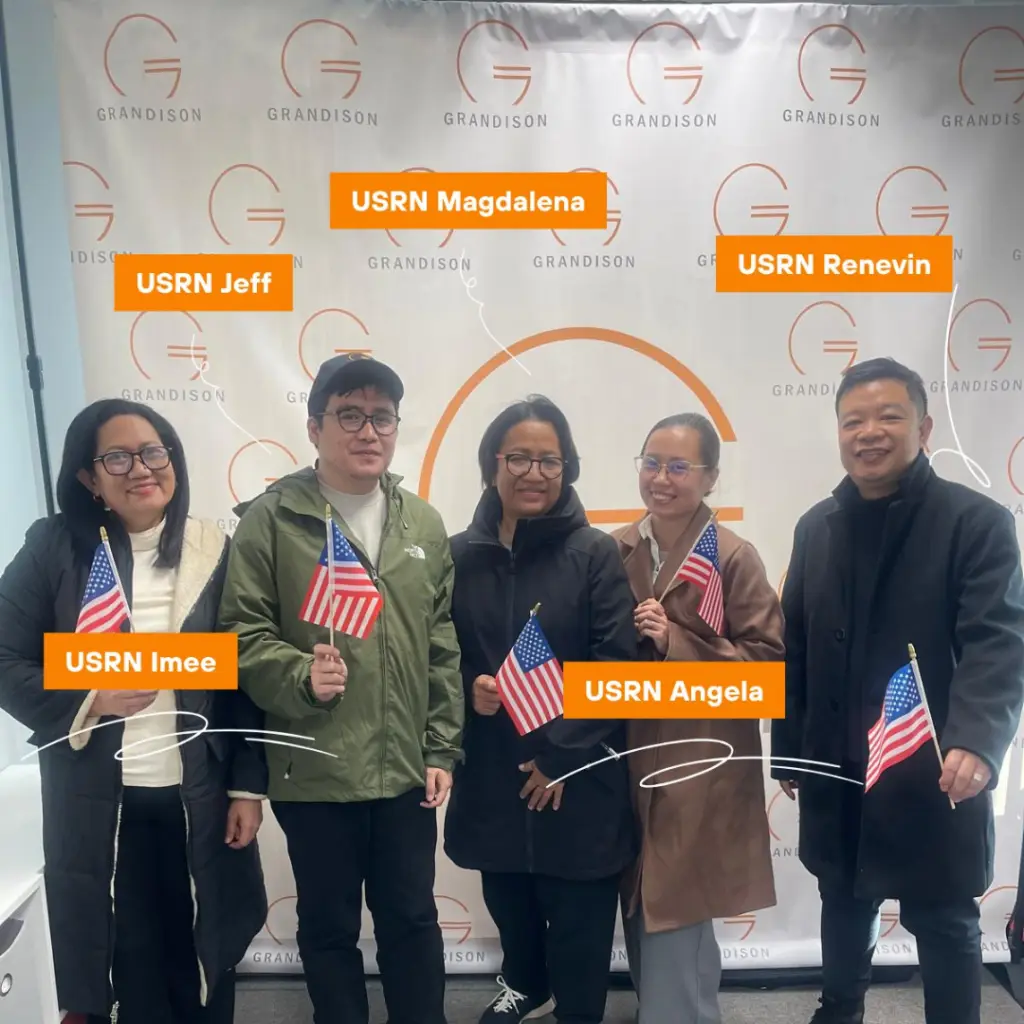
We are happy to announce recent nurses who have completed their contract with Grandison! This shows our commitment to our employees and also our employees trust with the Grandison Nursing program.


